We value excellent academic writing and strive to provide outstanding essay writing service each and every time you place an order. We write essays, research papers, term papers, course works, reviews, theses and more, so our primary mission is to help you succeed academically We would like to show you a description here but the site won’t allow blogger.com more Jun 27, · Find all the latest news on the environment and climate change from the Telegraph. Including daily emissions and pollution data
Google Translate
A pig is any of the animals in the genus Suswithin the even-toed ungulate family Suidae. Pigs include domestic pigs and their ancestor, the common Eurasian wild boar Sus scrofaalong with other species. Pigs, like all suidsare native to dissertation upon roast pig full text Eurasian dissertation upon roast pig full text African continentsranging from Europe to the Pacific islands.
Suids other than the pig are the babirusa of Indonesia, the pygmy hog of South Asia, the warthog of Africa, and other pig genera from Africa. The suids are a sister clade to peccaries. Juvenile pigs are known as piglets. With around 1 billion individuals alive at any time, the domestic pig is among the most populous large mammals in the world.
The Online Etymology Dictionary provides anecdotal evidence as well as linguistic, saying that the term derives. Originally "young pig" the word for adults was swine. Apparently related to Low German biggeDutch big "but the phonology is difficult" -- OED. Synonyms grunteroinker are from sailors' and fishermen's euphemistic avoidance of uttering the word pig at sea, a superstition perhaps based on the fate of the Gadarene swinewho drowned.
The Online Etymology Dictionary also traces the evolution of sowthe term for a female pig, through various historical languages:. An adjectival form is porcine. Another adjectival form technically for the subfamily rather than genus name is suine comparable to bovinecanineetc. A typical pig has a large head with a long snout that is strengthened by a special prenasal bone and by a disk of cartilage at the tip.
There are four hoofed toes on each foot, with the two larger central toes bearing most of the weight, but the outer two also being used in soft ground. The dental formula of adult pigs is 3. The rear teeth are adapted for crushing. In the male, the canine teeth form tuskswhich grow continuously and are sharpened by constantly being ground against each other.
Occasionally, captive mother pigs may savage their own piglets, often if they become severely stressed. Others may cause the death of the piglets and sometimes, the mother may eat the piglets.
With around 1 billion individuals alive at any time, the domestic pig is one of the most numerous large mammals on the planet. The ancestor of the domestic pig is the wild boarwhich is one of the most numerous and widespread large mammals, dissertation upon roast pig full text. Its many subspecies are native to all but the harshest climates of continental Eurasia and its islands and Africa as well, from Ireland and India to Japan and north to Siberia.
Long isolated from other pigs on the many islands of Indonesia, Malaysia, and the Philippines, pigs have evolved into many different species, including wild boar, bearded pigs, and warty pigs. Humans have introduced pigs into Australia, North and South America, and numerous islands, either accidentally as escaped domestic dissertation upon roast pig full text which have gone feralor as wild boar. The wild boar Sus scrofa can take advantage of any forage resources.
Therefore, dissertation upon roast pig full text, they can live in virtually any productive habitat that can provide enough water to sustain large mammals such as pigs. If there is increased foraging of wild boars in certain areas, they can cause a nutritional shortage which can cause the pig population to decrease.
If the nutritional state returns to normal, the pig population will most likely rise due to the pigs' naturally increased reproduction rate. Pigs are omnivoreswhich means that they consume both plants and animals. In the wild, they are foraging animals, primarily eating leaves, roots, fruits, and flowers, in addition to some insects and fish.
As livestock, pigs are fed mostly corn and soybean meal [13] with a mixture of vitamins and minerals added to the diet. Traditionally, they were raised on dairy farms and called "mortgage lifters", due to their ability to use the excess milk as well as whey from cheese and butter making combined with pasture. Most of the pigs on earth today are domesticated pigs raised for meat dissertation upon roast pig full text as pork.
Miniature breeds are commonly kept as pets. Both wild and feral pigs are commonly hunted. Apart from meat, the skin of pigs is used to make leatherand their bristly hairs which are used to make brushes. The relatively short, stiff, coarse hairs of the pig are called bristlesand were once so commonly used in paintbrushes that in the Australian Government launched Operation Pig Bristle.
In Mayin response to a shortage of pig bristles for paintbrushes to paint houses in the post-World War II construction boom, dissertation upon roast pig full text, the Royal Australian Air Force RAAF flew in 28 short tons of pig bristles from China, their only commercially available source at the time.
Human skin is very similar to pig skin, therefore pig skin has been used in many preclinical studies. The genus Sus is currently thought to contain eight living species.
The pygmy hogformerly Sus salvaniusis now placed in the monotypic genus Porcula. Pigs have been domesticated since ancient times in the Old World. Pigs were domesticated on each end of Eurasia, and possibly several times. Pigs were also domesticated in China, possibly more than once.
In India, pigs have been domesticated for a long time mostly in Goa and some rural areas for pig toilets. This was also done in China.
Pigs were brought to southeastern North America from Europe by Hernando de Soto and other early Spanish explorers. As in Medieval Europe, pigs are valued on certain oceanic islands for their self-sufficiency, which allows them to be turned loose, although the practice is not without its drawbacks see environmental impact.
The domestic pig Sus scrofa domesticus is usually given the scientific name Sus scrofaalthough some taxonomists call it S. domesticusreserving S. scrofa for the wild boar. It was domesticated approximately 5, to 7, years ago.
The upper canines form sharp distinctive tusks that curve outward and upward. Compared to other artiodactyles, their head is relatively long, pointed, and free of warts. Their head and body length ranges from 0. In Novemberscientists dissertation upon roast pig full text to sequence the genome dissertation upon roast pig full text the domestic pig.
The similarities between the pig and human genomes mean that the new data may have wide applications in the study and treatment of human genetic diseases. In Augusta study looked at over pig genome sequences to ascertain their process of domestication. The process of domestication was assumed to have been initiated by humans, involved few individuals and relied on reproductive isolation between wild and domestic forms.
The study found that the assumption of reproductive isolation with population bottlenecks was not supported. The study indicated that pigs were domesticated separately in Western Asia and China, with Western Asian pigs introduced into Europe where they crossed with wild boar. A model that fitted the data included admixture with a now extinct ghost population of wild pigs during the Pleistocene. The study also found that despite back-crossing with wild pigs, the genomes of domestic pigs have strong signatures of selection at DNA loci that affect behavior and morphology.
The study concluded that human selection for domestic traits likely counteracted the homogenizing effect of gene flow from wild boars and created domestication islands in the genome. The same process may also apply to other domesticated animals. Pigs have been important in culture across the world since neolithic times. They appear in artliterature, and religion. In Asia the wild boar is one of 12 animal images comprising the Chinese zodiacwhile in Europe the boar represents a standard charge in heraldry.
In Islam and Judaism pigs and those who handle them are viewed negatively, and the consumption of pork is forbidden. Pigs have been brought into literature for varying reasons, dissertation upon roast pig full text, ranging from the pleasures of eating, as in Charles Lamb 's A Dissertation upon Roast Pigto William Golding 's Lord of the Flies with the fat character "Piggy"where the rotting boar's head on a stick represents Beelzebub"lord of the flies" being the direct translation of the Hebrew בעל זבוב, and George Orwell 's allegorical novel Animal Farmwhere the central characters, representing Soviet leaders, are all pigs.
Domestic pigs that have escaped from urban areas or were allowed to forage in the wild, and in some cases wild boars which were introduced as prey for hunting, have given rise to large populations of feral pigs in North and South America, Australia, New Zealand, Hawaii, dissertation upon roast pig full text, and other areas where pigs are not native.
Accidental or deliberate releases of pigs into countries or environments where they are an alien species have caused extensive environmental change. Their omnivorous diet, aggressive behaviour, and their feeding method of rooting in the ground all combine to severely alter ecosystems unused to pigs.
Pigs will even eat small animals and destroy nests of ground nesting birds. Feral pigs like other introduced mammals are major drivers of extinction and ecosystem change. They have been introduced into many parts of the world, and will damage crops and home gardens as well as potentially spreading disease. They uproot large areas of land, eliminating native vegetation and spreading weeds. This results in habitat alteration, a change in plant succession and composition dissertation upon roast pig full text a decrease in native fauna dependent on the original habitat.
Because of the biological similarities between each other, pigs can harbour a range of parasites and diseases that can be transmitted to humans. These include trichinosisTaenia soliumcysticercosisand brucellosis. Pigs are also known to host large concentrations of parasitic ascarid worms in their digestive tract. Some strains of influenza are endemic in pigs, the most significant of which are H1N1H1N2and H3N2the former of which has dissertation upon roast pig full text several outbreaks among humans, including the Spanish fluRussian flu pandemicand the swine flu pandemic.
Pigs also can acquire human influenza. From Wikipedia, the free encyclopedia. Redirected from Pigs. This article is about the genus. For other uses, dissertation upon roast pig full text, see Pig disambiguation. genus of even-toed ungulates. Temporal range: Early Pleistocene to recent. Further information: Pig farming. Main article: Domestic pig § In human healthcare.
Pig 'oink'. Main article: Domestic pig. Main article: Pigs in culture. Main article: Environmental impacts of pig farming, dissertation upon roast pig full text.
See also: Swine influenza. Animals portal.
A Dissertation Upon Roast Pig by Charles Lamb
, time: 15:32Essay Writing Service - blogger.com
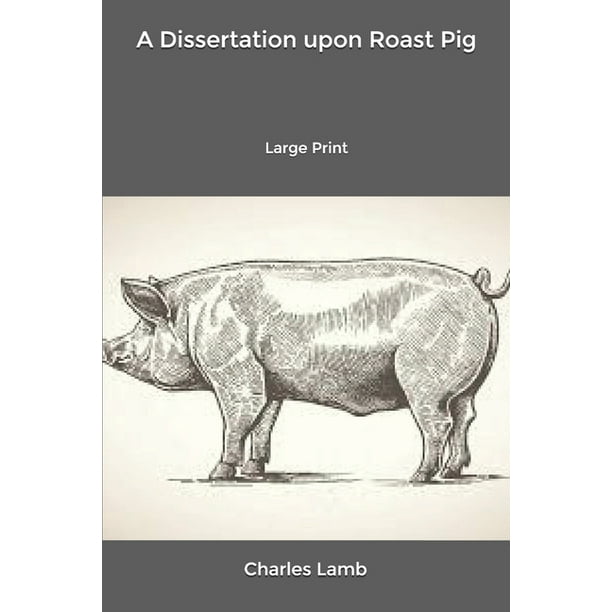
A pig is any of the animals in the genus Sus, within the even-toed ungulate family blogger.com include domestic pigs and their ancestor, the common Eurasian wild boar (), along with other blogger.com, like all suids, are native to the Eurasian and African continents, ranging from Europe to the Pacific blogger.com other than the pig are the babirusa of Indonesia, the pygmy hog of South Asia Jun 27, · Find all the latest news on the environment and climate change from the Telegraph. Including daily emissions and pollution data We would like to show you a description here but the site won’t allow blogger.com more


No comments:
Post a Comment